
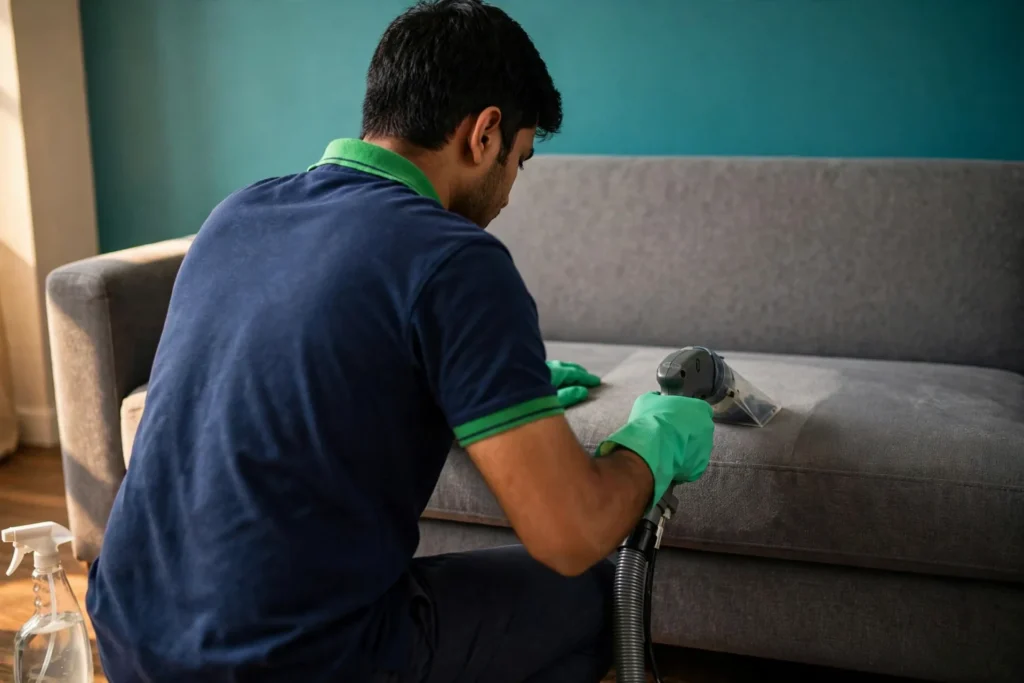
Sofa-cleaning frequency should be based on use, fabric, spills and visible condition rather than one universal calendar rule. Routine vacuuming and prompt spot care can reduce how often a full professional clean is needed.
Start with the manufacturer’s care instructions
Check the furniture label and manufacturer guidance before applying moisture, solvent or a machine method. Upholstery cleaning codes such as W, S, W-S/WS and X can indicate broad restrictions, but they are not permission to saturate a fabric or a guarantee that a stain will come out. Fabric, backing, filling, trims, dyes and previous treatments can all affect method selection.
Clean sooner when condition justifies it
- A spill has left visible residue or a ring.
- Body oils or soil are visible on arms, headrests or frequently used cushions.
- Pet hair or tracked soil is accumulating faster than routine vacuuming controls it.
- An odour persists after obvious removable sources have been addressed.
- The sofa is heavily used and routine maintenance no longer restores an even appearance.
Routine maintenance between deeper cleans
- Vacuum with a suitable upholstery attachment, including crevices where accessible.
- Blot fresh spills rather than rubbing them deeper into the textile.
- Follow the manufacturer’s instructions for removable covers; do not assume every cover is machine washable.
- Avoid experimenting with strong household chemicals on an unknown fabric.
- Test any permitted spot-treatment method in an inconspicuous area first.
When professional assessment makes sense
Consider professional assessment for widespread soil, delicate or unknown fabric, recurring spots, large liquid spills, colour-transfer risk or when the care instructions restrict ordinary home methods. Cleaning also cannot reverse wear, sun fading, abrasion or damaged fibres.
See Sofa Cleaning Dubai for the relevant professional service scope.
Different sofa problems need different responses
- Loose dust and crumbs: routine vacuuming may be enough.
- Fresh spill: blot promptly and follow the fabric/manufacturer instructions.
- General body soil: a broader upholstery clean may be appropriate when routine maintenance no longer restores an even appearance.
- Permanent fading or abrasion: cleaning will not restore lost colour or worn fibres.
- Large liquid penetration: assess the cushion filling and drying risk rather than treating only the visible surface.
Understand upholstery cleaning codes—but do not overinterpret them
Where present, upholstery codes can indicate whether water-based or solvent-based methods are broadly permitted. They do not describe every fibre, dye, backing, adhesive or filling inside the furniture. A code is a restriction guide, not a guarantee that a particular stain remover or extraction method is safe.
Why spots sometimes return after cleaning
A spot can reappear when residue remains in the textile, when soil-attracting cleaner was not adequately removed, or when contamination deeper in a cushion migrates toward the surface during drying. Repeatedly adding more product can make the problem worse. Identify the cause before treating the same area again.
Drying is part of the cleaning process
Ventilation, humidity, fabric construction, cushion density and the amount of moisture used all affect drying. Keep the sofa out of normal use until treated areas are fully dry. More water is not automatically more cleaning power.
Questions to ask an upholstery cleaner
- How will the fabric and construction be assessed?
- What method is proposed and why is it suitable?
- How will colourfastness or delicate areas be checked?
- What stains or damage may not be removable?
- What drying conditions should be maintained after the service?
Frequently asked questions
Should every sofa be professionally cleaned once a year?
Not as a universal rule. Usage, fabric, maintenance and condition vary too much. Follow manufacturer guidance and clean when condition warrants it.
Can I use a carpet machine on my sofa?
Do not assume so. Upholstery construction and care instructions can require a different method.
Will cleaning remove every stain?
No. Some stains alter dyes or fibres permanently, and some apparent stains are wear or fading rather than removable soil.
Need Help With This Cleaning Task?
Explore the relevant service page for scope and quote information.